
Safari destination
Tsavo West National Park
Lava, lions and the crystal pools of Mzima Springs beneath Kilimanjaro.
Area
Tsavo West National Park is 9,065 sq km
Location
The park is located in South East Kenya
Climate
Tsavo West National Park is Warm to hot and dry.
Temperatures range from 20 – 30° C.
Annual rainfall of 200 – 700 mm occurs in the “long rains” of March – May and the “short rains” of October – December.
Opening hours
The park is open daily from 0600hrs to 1800hrs.
No park entry is allowed after 1815hrs.
No entry allowed on foot.
Walking and hiking is only allowed in designated areas and in the company of a KWS ranger.
Contact the tsavo national park safari operator for specific information.
When to go
The Tsavo West National Park is open all year round.
Ancient Land of Lions and Lava
World famous Tsavo West National Park, with its Tsavo East neighbour, combine to form one of the largest national parks in the world.
Beckoning are the ancient lands of lava and lions, resembling a masterpiece painted on a sprawling canvas of endless skies, emerald hills and palm-fringed rivers. Amidst abundant wildlife, sparkling oases blend with the unforgettable sunrise or sunset backdrop of Mt Kilimanjaro, “the roof-top of Africa”.
Exhale, unwind and allow Tsavo West to cast its everlasting spell!
Vast Vistas and Volcanic Views
The immense Tsavo West stretches from the northeastern Athi river to the southwestern Tanzania border. With rocky outcrops in its northern parts, most of the park is a vast tangled bushland savannah, laced with volcanic ridges and lava beds. With its sweeping hills reaching 1,800 metres high, the Ngulia range offers dramatic vistas, while Chyulu Hills, adjacent to Tsavo West, feed the remarkable Mzima Springs where thousands of gallons of crystal-clear freshwater gushes into palm fringed pools, filled with hippos and crocodiles. Ancient and recent volcanic activity is evident within and around the park. Visit Shetani or Devils Lava Flow formed a few hundred years ago when a fiery molten fury spewed from the earth! Or climb to Chaimu Crater – in a mere 10 minutes. And stop by the eerie “Roaring Rocks” , named after the buzz of the cicadas that inhabit them and the howl of the wind as it rushes past the sheer face of the scarp. From the Park’s many panoramic vantage points, absorb the vast vistas as you monitor the movement of the wildlife herds below. The finest of Poachers Lookout, a roofed hut high on a hill with views to eternity.
Wondrous Wildlife
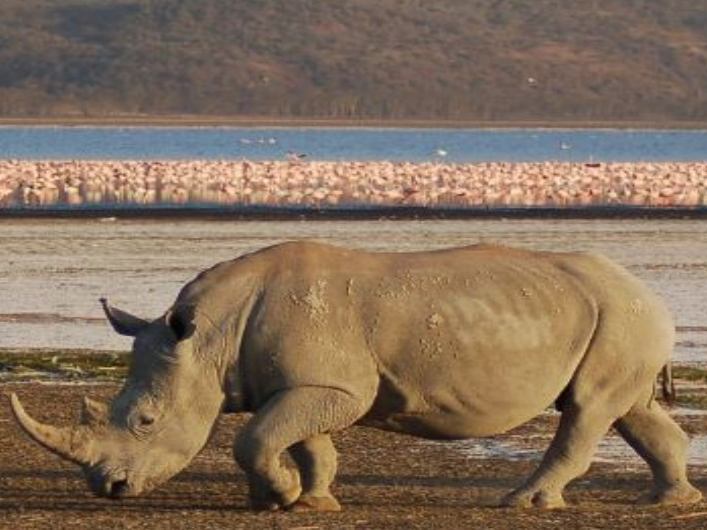
The world’s most magnificent game viewing awaits you! Vast herds of dust-red elephant, fat pods of hippo, giant crocodiles, teeming herds of savannah dwellers plus a fantasia of birds and magical flora flourish here. The Ngulia Rhino Sanctuary protects Tsavo’s growing population of endangered black rhino, successfully inching their way back from the brink of extinction caused by rampant poaching in the 1960’s. Beautiful Lake Jipe, straddling the Kenya/Tanzania border, offers memorable experiences of abundant aquatic and bird life viewing – from a hired boat!
Mzima Springs Magic
The lush, hippo inhabited pools of Mzima Springs are a verdant cooling oasis. An underwater hippo-viewing chamber, two nature trails and some scenic picnic spots provide a refreshing and rewarding adventure. And a romantic spot too!
Wildlife At the Tsavo West National Park
Kenya’s largest national park supports ALL the “Big Five”! Home to the country’s largest herd of elephant population, your exciting safari is sure to include buffalo, lion, leopard and rhino too. Plus at Mzima Springs, abundant Nile crocodile and hippo. Herds of giraffe, gerenuk, oryx, zebra and impala range through bush and plains, as do hartebeest, lesser kudu, eland, water buck, Steenbok, Kirk’s Dik Dik and klipspringer. Don’t miss yellow baboons and vervet monkeys as they cavort noisily around acacia trees.
Birds
Prolific bird life – featuring over 600 recorded species – are a true highlight. Birds of the semi-arid zone, such as somali ostrich and golden pipit, slip by the the more conspicuous white-headed buffalo weaver and its vivid coral rump displayed in flight, or the brilliantly plumaged golden-breasted starling. Raucous hornbill, with their lilting flight, are also prevalent in the park as are hole-nested birds, such as orange-bellied parrot, and D’Arnaud’s barbet that favour the thick-trunked baobab trees.
Roaring Rocks is an excellent spot for raptors: eagles cruise by at eye level and Bateleur comb the rocky scarp for unsuspecting prey. The Ngulia area, due in part to its geography, forms a focus for innumerable Eurasian and Palaearctic migrating birds. A palaearctic migratory bird-banding (bird-ringing) project is at Ngulia Lodge. Vegetation.
Ranging from woodland to semi-desert, Tsavo West covers a diverse array of habitats.
For the most part. the area is hot and dry, with acacia-commiphora scrub broken by short grassy plains flecked with thorn trees.
Wild flowers appear with the short rains and the ground can be quickly carpeted with delicate thunbergia, ipomoea and barleria.
Watch for the blazing fire-balllily and the delonix, a sparsely branched tree with exquisite white blooms, pollinated by nocturnal bats.
Rivers are fringed with acacias as magnificent baobabs rise leafless above the shimmering heat.
Day-by-day safaris
Safaris that visit this park
Keep exploring
More Kenya Safaris
Visit Tsavo West on safari
Tsavo West features on several of our Kenya safaris. Tell us your dates and we will plan it with you.
Accreditations & booking security




Follow the safari
See Kenya Through Our Lens
Wildlife moments, lodge tours and trip stories from our guides and guests.